

The Human Mind — Friend or Foe?
Blog post description. There’s a scene I’ve seen play out a thousand times. A student sits down to study, opens the book, and within two minutes… the battle begins. “Focus!” the mind says. Then a whisper follows, “Maybe check your phone once? Just one video…” And that’s it — game over. The student didn’t lose to a hard chapter or a tough question — they lost to their own mind. If that’s ever happened to you (and let’s be honest, it happens to all of us), don’t feel guilty. The mind isn’t your enemy. It’s just powerful — and a little wild. The goal isn’t to fight it, but to understand it.
10/27/20253 min read
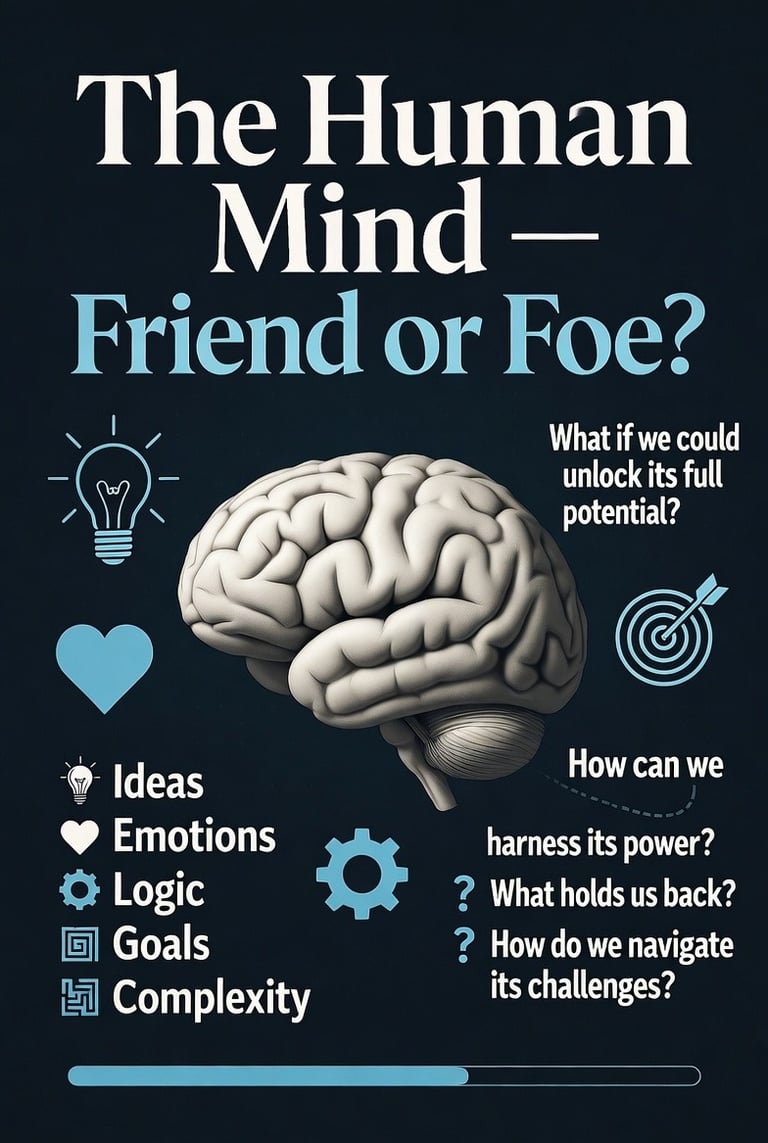
The Human Mind — Friend or Foe?
When students tell me, “Sir, I want to study, but my mind doesn’t cooperate,” I smile — because I know exactly what that feels like. You sit down with full intention, open your book, and within minutes, your thoughts start wandering: What’s new on YouTube? Should I check my phone once? And just like that, the mind — your most powerful ally — turns into your biggest distraction.
Here’s the thing: the mind itself is not the problem. The real issue is our lack of understanding of how it works. We try to control it through force — “I must focus! I must not get distracted!” — but force never works for long. The mind isn’t a machine to be bullied; it’s more like a child to be understood.
1. The Two Faces of the Mind
Your mind has two sides:
One that thinks, analyses, and reasons — your intellect.
Another that feels, reacts, and desires — your emotion.
When these two are in sync, you experience flow: clarity, energy, and purpose. But when they fight, you feel confusion, irritation, or laziness. For example, your intellect says, “Let’s revise one more chapter,” while your emotions whisper, “Let’s scroll Instagram for five minutes.”
The result? You get stuck between intention and impulse.
Self-mastery begins the moment you notice this inner dialogue. Awareness itself is power. The more you observe the tug-of-war, the more control you gain.
2. Your Thoughts Create Your Inner Climate
Every thought you think leaves an emotional trace.
Negative thoughts don’t just disturb focus — they drain mental energy.
When you say, “I can’t remember anything”, your brain actually listens and adjusts its performance downward.
Try reversing the statement:
Instead of “I can’t focus,” say, “I’m learning to focus.”
Instead of “I’m weak in reasoning,” say, “I’m improving daily.”
This isn’t empty positivity — it’s cognitive training. You’re reshaping your neural pathways through language and attention. Over time, your inner voice becomes your personal coach, not your critic.
3. Understanding the Mind’s Default Mode
The mind constantly seeks stimulation — something new, something emotional, something rewarding. That’s why social media hooks you: it’s designed to exploit your brain’s need for novelty.
But if you observe carefully, the same mechanism can help you in studies too. When you make learning interesting and goal-linked, the mind’s natural curiosity wakes up.
For example, instead of thinking “I have to study geography,” ask yourself, “How does this chapter connect with real life or the world I live in?”
Once the brain senses purpose, attention follows naturally.
4. The Art of Being the Observer
Most students live inside their mind — they are constantly carried away by thoughts.
The shift happens when you learn to observe your mind instead of being ruled by it.
Try this simple mental exercise:
Next time you feel restless, close your eyes and silently say,
“I am aware that my mind is restless.”
You’ll notice something amazing: the moment you become aware, restlessness loses power.
This is the beginning of mental separation — you’re no longer the chaos, you’re the one watching it.
This technique is ancient — it’s the seed of both mindfulness and the Yogic idea of Pratyahara (withdrawal of the senses).
5. Friend or Foe — You Decide
Your mind can be your best ally or your worst distraction. It depends on how you relate to it.
If you chase every thought, it’ll exhaust you.
If you learn to observe and direct it, it’ll serve you.
Every great student, athlete, or professional eventually learns one truth:
Mastery doesn’t start with the subject — it starts with the mind studying the subject.
Reflection Exercise: “Know Your Mind”
Step 1: Sit quietly for 3 minutes.
Step 2: Notice the flow of thoughts — don’t stop them, just watch.
Step 3: After 3 minutes, write down what kind of thoughts dominated:
· Future worries
· Past memories
· Random distractions
· Study-related ideas
Do this once a day for a week.
By the end of seven days, you’ll have your first mental map. You’ll know what kind of thoughts drain you — and what kind support your growth.