

Habit Stacking: The Easiest Way to Build Good Habits Without Depending on Willpower
Blog post description. Have you ever promised yourself, "From tomorrow, I'll start exercising," or "I'll read every day," only to find that the nthusiasm disappears within a week? You're not alone. Most of us don't fail because we lack motivation.
Dr AMBIKA and Y SIDHARTH
7/12/20263 min read

Habit Stacking: The Easiest Way to Build Good Habits Without Depending on Willpower
Have you ever promised yourself, "From tomorrow, I'll start exercising," or "I'll read every day," only to find that the enthusiasm disappears within a week?
You're not alone.
Most of us don't fail because we lack motivation. We fail because we're trying to fit a new habit into our lives without giving it a place to belong.
This is where habit stacking, a concept popularized by James Clear in his book Atomic Habits, can make a surprising difference.
So, what exactly is habit stacking?
The idea is beautifully simple.
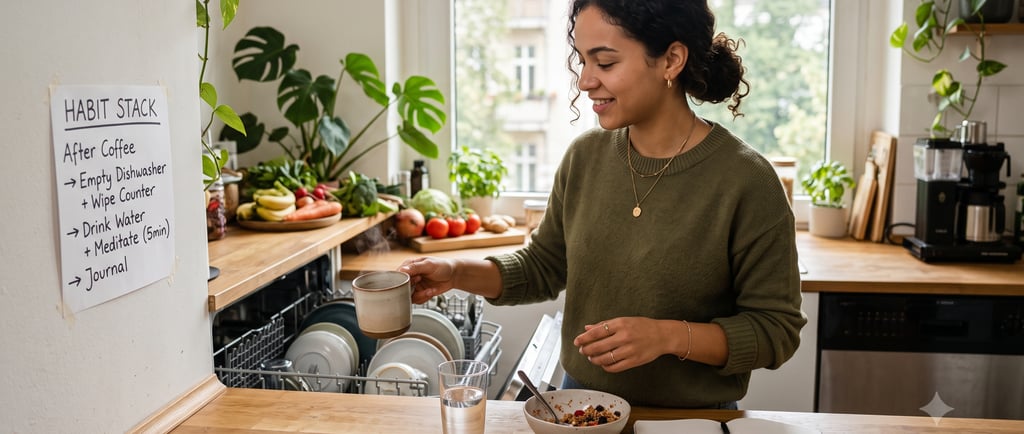
Instead of trying to remember a brand-new habit, you connect it to something you already do every single day.
The formula looks like this:
After I __________, I will __________.
That's it.
Your existing habit becomes a reminder for the new one.
For example:
After I brush my teeth, I'll meditate for two minutes.
After I make my morning tea, I'll read one page of a book.
After lunch, I'll walk for ten minutes.
After I sit at my desk, I'll solve one reasoning question.
Notice how none of these feels difficult? That's exactly the point.
Why does this work so well?
Our brains love routines.
Think about brushing your teeth. You probably don't need an alarm or a motivational speech to do it. It's automatic.
Now imagine placing one tiny habit immediately after brushing your teeth. Since the first habit already happens every day, the second one gets a free ride.
It's like adding another coach to a train that's already moving.
The train doesn't need to start again—it simply carries one more coach along with it.
Here's where many people go wrong
When we decide to improve ourselves, we often think big.
"I'm going to exercise for an hour every day."
"I'm going to read fifty pages daily."
"I'm going to meditate for thirty minutes."
These goals sound inspiring... until real life gets in the way.
A busy day, a late meeting, or a little tiredness is often enough to break the routine.
What if, instead, your goal was simply:
One push-up.
One page.
Two minutes.
One glass of water.
One practice question.
It sounds almost too easy.
But easy habits get repeated. Repeated habits become routines. And routines shape our lives.
Habit stacking for students
Students can use this technique without adding extra stress.
For example:
After opening my notebook, I'll revise yesterday's lesson for five minutes.
After every study session, I'll solve five practice questions.
After dinner, I'll review today's formulas before using my phone.
These tiny actions may not seem life-changing today, but over a year they can make a remarkable difference.
Habit stacking at work
The same idea works beautifully for professionals.
After checking my email, I'll identify my most important task.
After every meeting, I'll write a two-minute summary.
After reaching home, I'll spend fifteen minutes learning a new skill.
No complicated planning. No dramatic lifestyle changes. Just small improvements attached to routines that already exist.
The real secret
People often believe successful individuals have extraordinary discipline.
Perhaps they don't.
Maybe they've simply built better systems.
Habit stacking is one of those systems. It reduces the need for willpower because your routine reminds you what to do next.
Over time, those tiny actions stop feeling like effort. They simply become part of who you are.
One small challenge for you
Before you finish reading this article, think of one habit you already do every day.
Now ask yourself:
"What is one positive action I can attach to it?"
Keep that action so small that skipping it feels harder than doing it.
Try it for the next seven days.
You may be surprised to discover that lasting change doesn't begin with giant leaps. It begins with one small habit, quietly attached to another.
And that's how meaningful transformation often happens—one habit at a time.